Categories
Labour market

What labour market statistics means for UK PGT demand

We’ve previously been of the view that UK labour market statistics (as flawed as the ONS’s current output in this area is) offer some of the best insight into the future of UK demand for postgraduate taught study, at least on a macro level.

Overall UK PGT demand has previously closely followed labour market conditions, with a big rise in applications and enrolments in the early stage of the pandemic as job vacancies dramatically fell, employees were furloughed and anxiety about employment security increase. Demand from UK applicants then fell back as labour market conditions reversed from 2021 onwards, with high vacancies and strong pay growth reducing the incentives for PGT study. The theory here has been that if you’re already confident in your future career and earning prospects, you’re less likely to step away from this career to spend time and money on further study.

There are however signs that this relationship is now breaking down – excessive labour market tightness has now completely fallen away, with vacancies lower than in the years prior to the pandemic. Data on individual institutions’ UK PGT performance is hard to come by and sector level data only available with a long lag but there’s little to suggest that many are seeing a buoyant market with bumper recruitment.

It’s likely that this change has come about because another determinant of UK PGT demand – affordability – has become the more important obstacle for prospective applicants. Put simply, it’s likely that many more people in the UK now consider PGT study a worthwhile investment in themselves than a few years ago, but their ability to fund this investment has meanwhile fallen.

Categories
Demographics

Updated ONS population projections

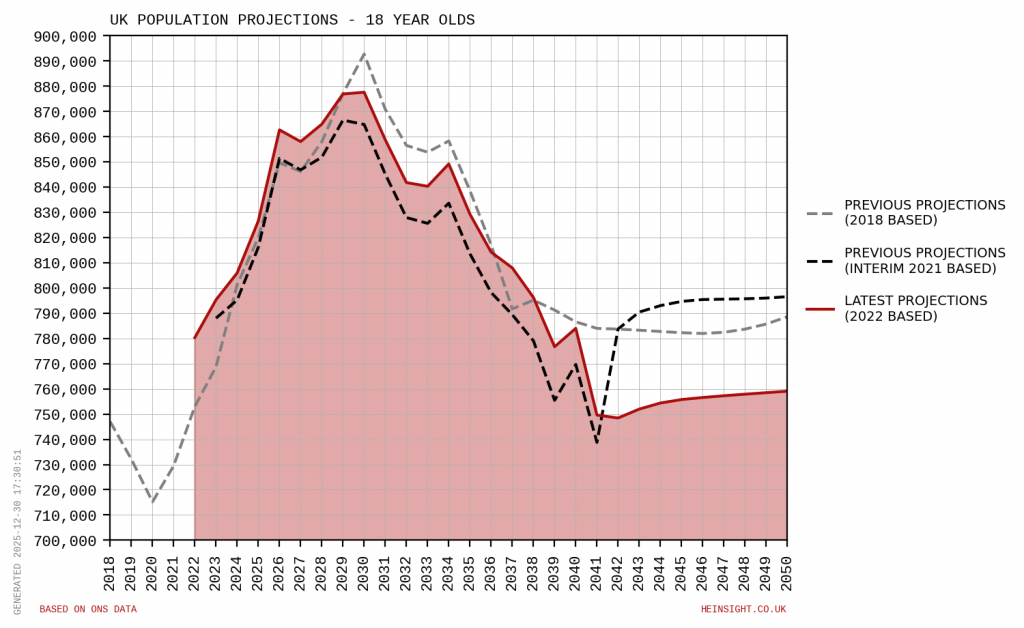
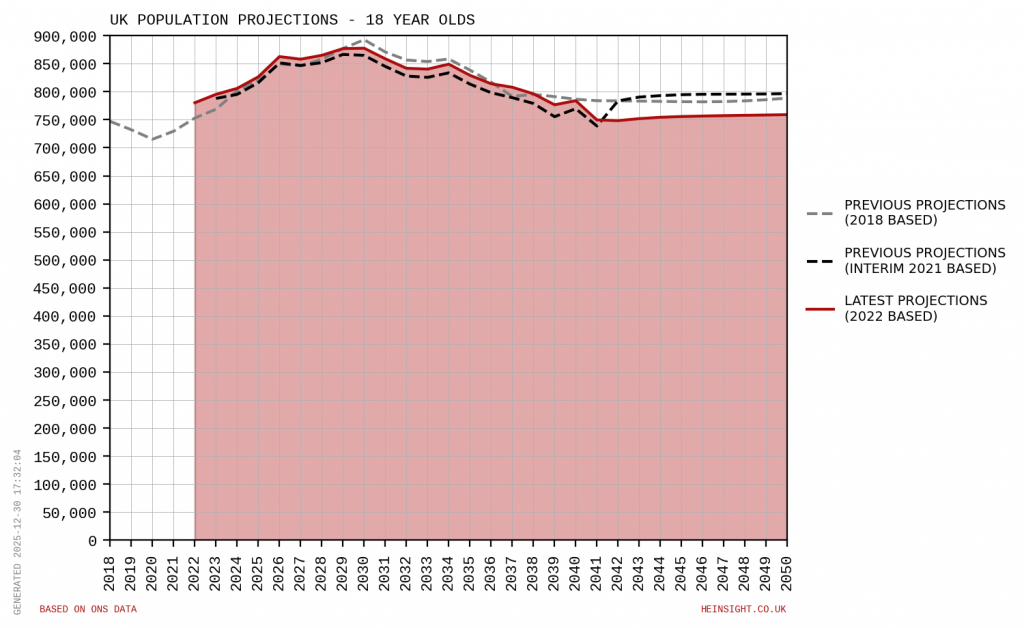
Back working with the ONS’s UK population projections for the first time in a little while today, plotting the latest set of projections released earlier this year.

The ONS’s projections have fluctuated significantly over the past few years and the key uncertainty is clearly migration, for which long-term expectations have been revised upward again, though expectations for future fertility and life expectancy improvements have meanwhile been revised downward.

The HE sector has long watched the projection of the 18 year old population as a measure of whether good times or bad times are on the way, though of course no number of 18 year olds will solve all the sector’s current ailments.

The good news is that the 2030 peak has been revised back upwards, though still sits lower than where projections prior to the pandemic estimated it to land.

The bad news is that once we’re through the good, the bad now looks worse. The projected steady state 18 year old population from the early-2040s onwards is now expected to be around 4.5% lower than previously thought. The early-2040s is of course when we start to talk about 18 year olds who have yet to be born, so this is almost entirely a product of lower expected births.

It’s looking increasingly likely that the late-2020s and early-2030s will be a demographic flash in the pan for UK universities, followed by a fall to a level not too far off the bottom of the previous dip in 2020.

Categories
Labour market

Economic inactivity and long-term sickness

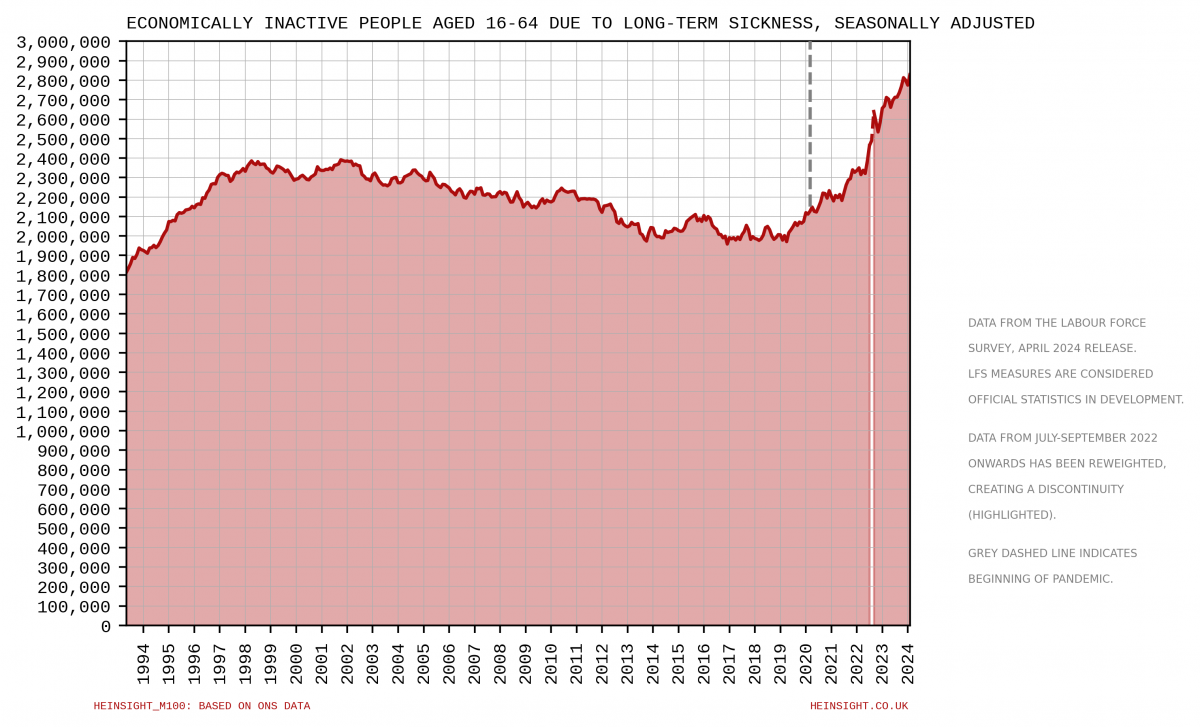
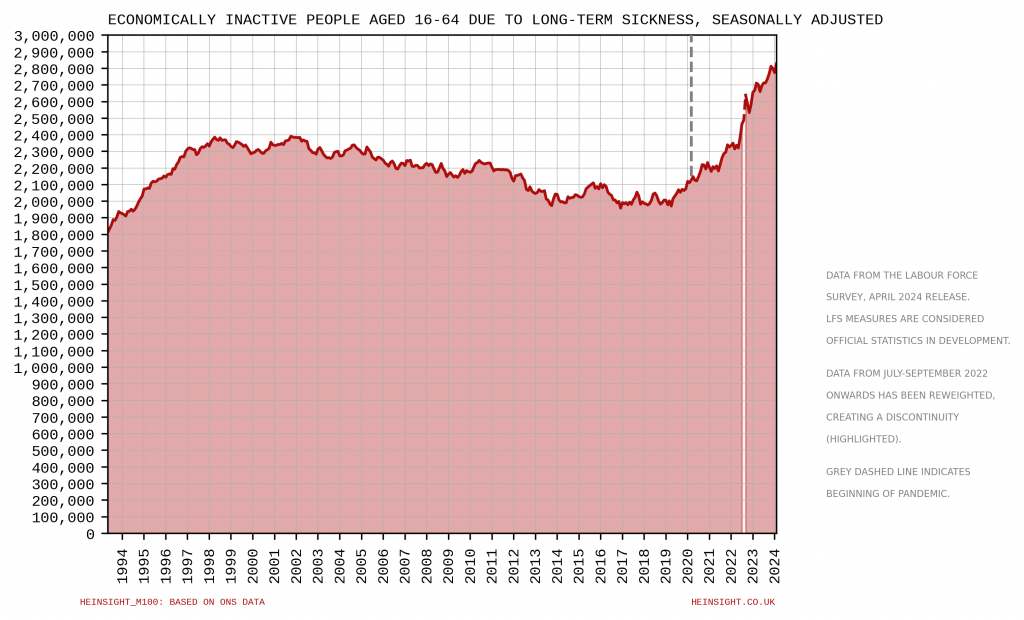
Fresh UK labour market data out today that demonstrates the extent to which labour shortages and poor health are holding back the economy.

Unemployment figures alone don’t give a full view of what’s happening – we need to look at the full range of reasons people are excluded from the workforce. The big thing that’s changed? The enormous rise in the number of working age people inactive due to long-term sickness.

On the eve of the pandemic there were estimated to be 2.1 million such people. Now, there’s estimated to be 2.8 million, the most there’s been for at least 30 years and an increase of 45% since April 2019.

Categories
Student recruitment

Our view on the prospects for UK postgraduate student recruitment

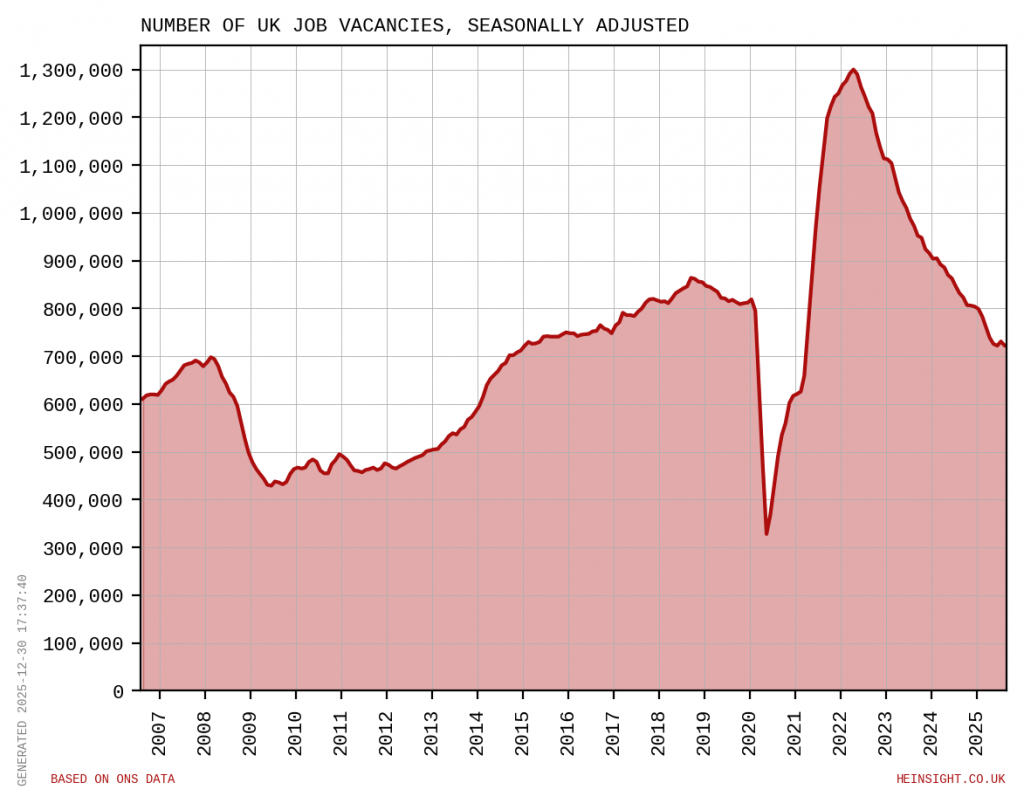
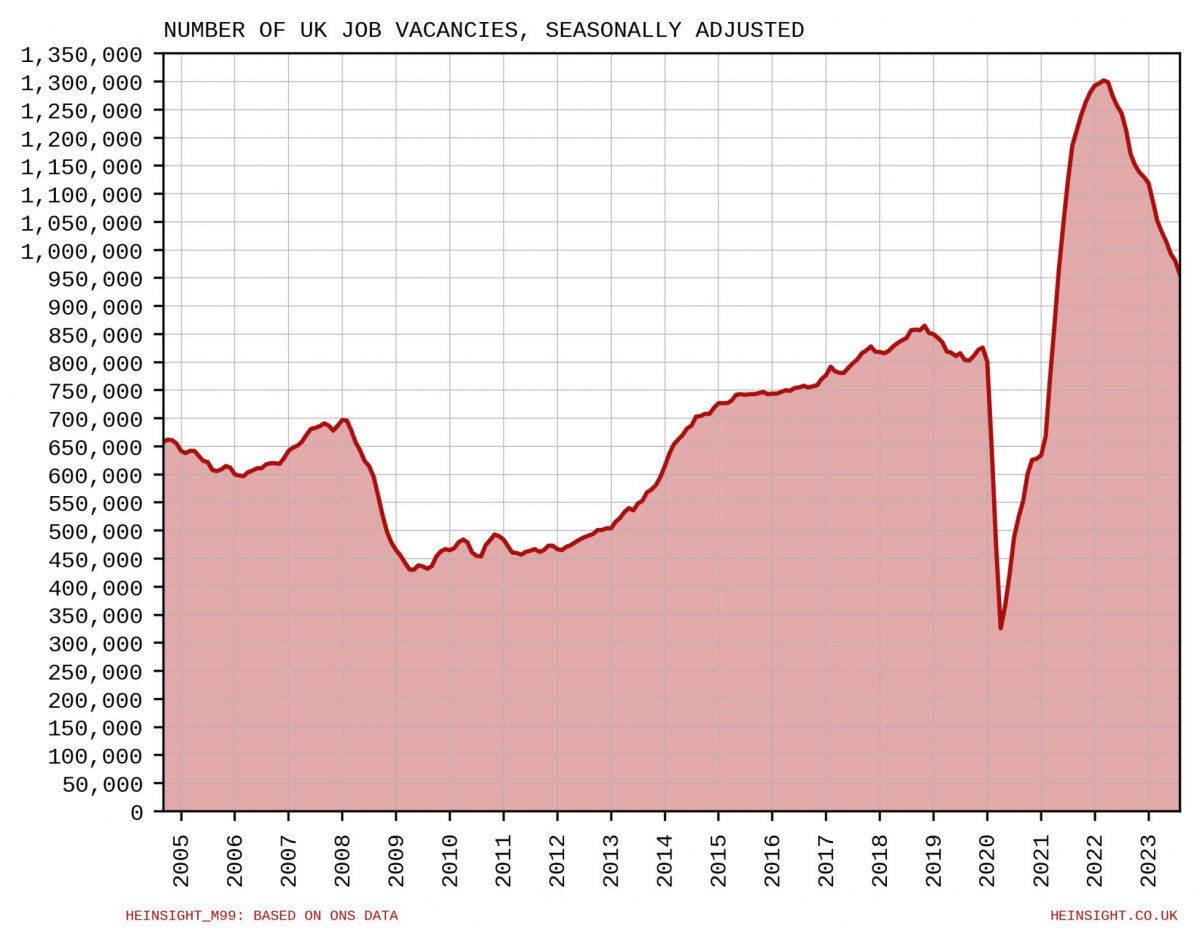
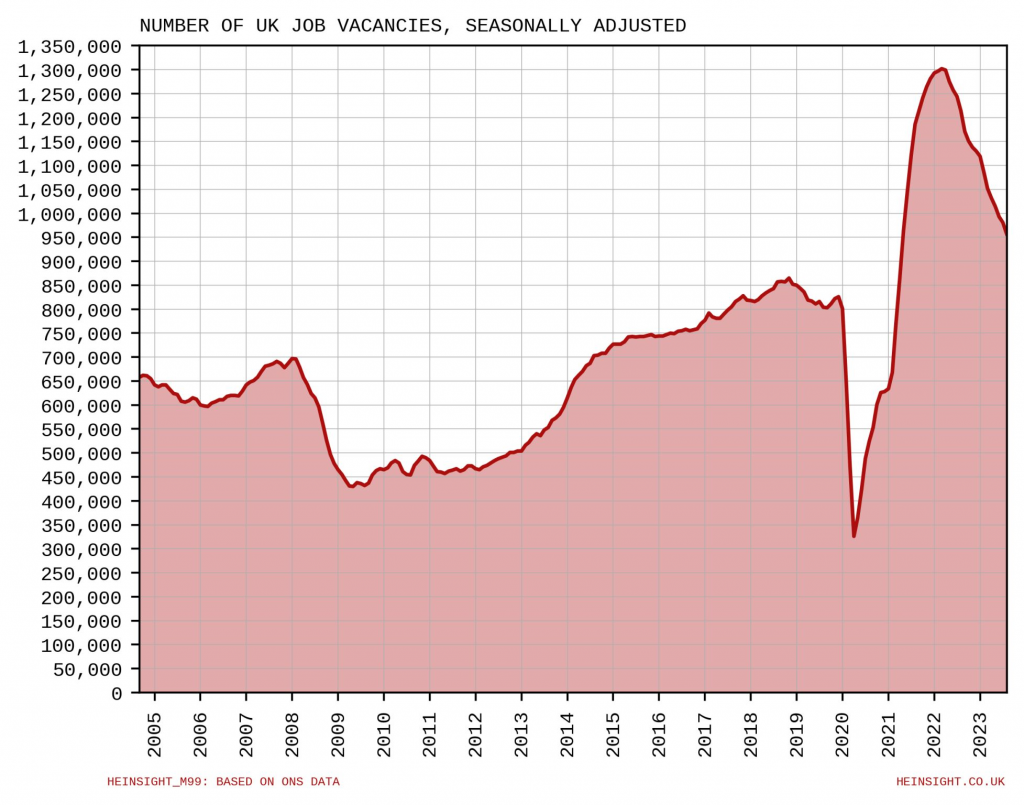
UK labour market conditions are the key determinant of incentives to undertake postgraduate study for the home market. Here’s the latest ONS data on job vacancies in the UK.

Vacancies are now consistently falling from their (unprecedented this side of the millennium) high last year but nonetheless remain significantly elevated. There are currently 21% more vacancies than the 2015-2019 average and 78% more than the 2020 average.

HESA data showed a surge in PGT Home enrolments across the sector in 2020/21, as job vacancies plumetted, many were subject to furlough and anxieties about job security increased. Since then many institutions have experienced successive drops in PGT Home intake as labour market conditions have tightened.

Higher vacancies don’t just make it easier for the unemployed to secure a job, they also make it easier for those already employed to secure promotions and payrises (data also shows payrises are remaining strong). If you perceive your position in the job market to be strong, as it is for many people in the UK at the moment, you’re less likely to consider taking time out of earning to invest in further study.

Vacancies will likely continue to fall from here but UK-specific structural factors – namely Brexit and unusually high levels of long term illness – may prevent them from returning to the long term average for some time. If the Bank of England begins to loosen monetary policy next year, as has become more likely given better than expected inflation data released today, this may further slow the return to normality.

Even if vacancies return to near the 2015-2019 average by the start of the 2024/25 academic year, we should expect there to be a lag in this feeding through to prospective applicant perceptions. We should also expect that the elevated costs of postgraduate study compared to the 2015-2019 period (when postgraduate loans had been newly introduced, their value not yet eroded by inflation and sector-wide tuition fees were notably lower) will make it more difficult to achieve pre-pandemic levels of intake even when labour market conditions become similar.

The prospects for UK postgraduate student recruitment will improve in the medium term but we’re not out of the woods yet.

Categories
Tuition fees

Average Home Postgraduate Taught tuition fees

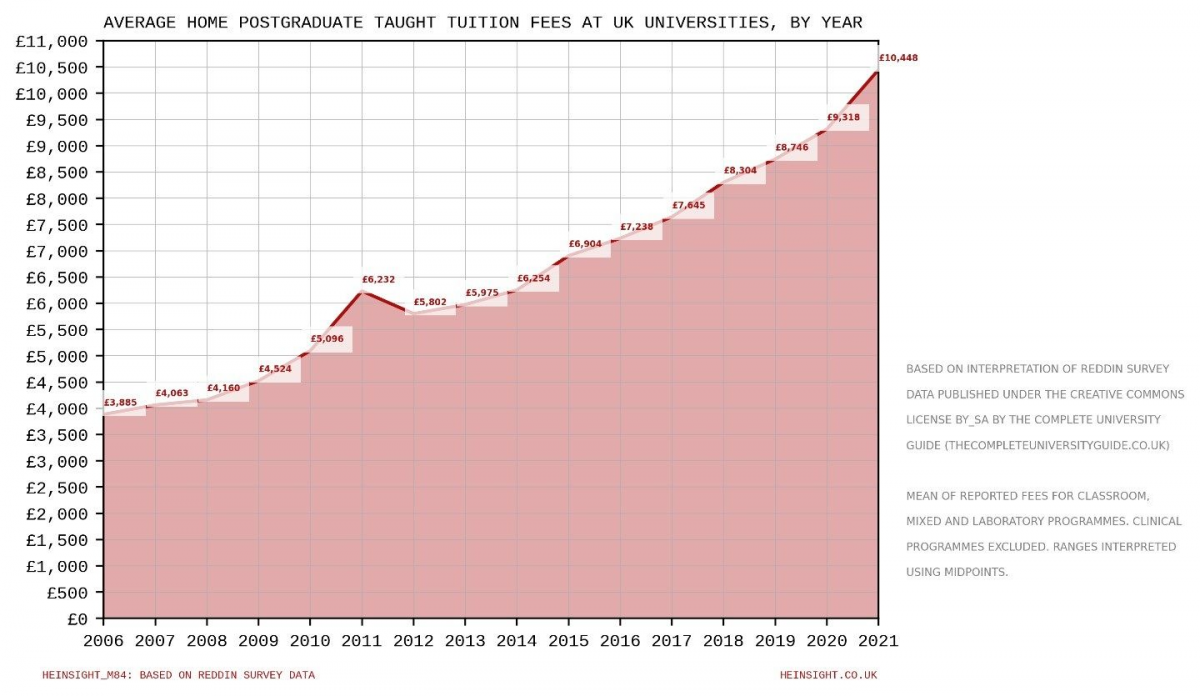
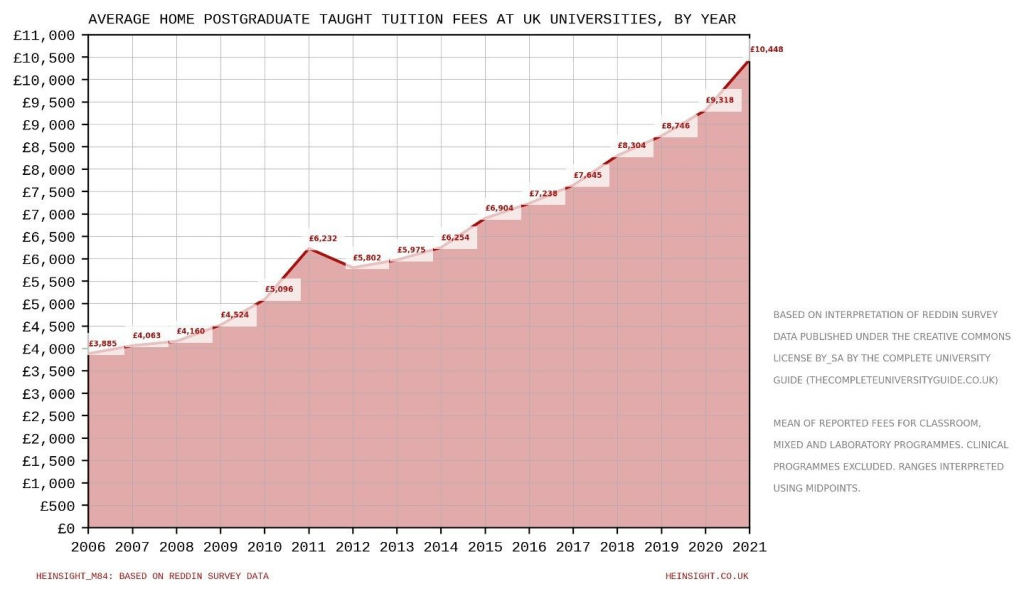
There’s a great deal of variety in the amount that UK universities charge Home students for postgraduate taught programmes but a look at the average over time shows a clear trend.

Excluding clinical programmes, by our measure the average tuition fee in 2021 was 80% higher than it was in 2012.

————————
Based on data from the Reddin Survey, published by The Complete University Guide (https://www.thecompleteuniversityguide.co.uk) under Creative Commons License BY-SA.

Categories
Inflation Student loan

Inflation and the Postgraduate Master’s Loan

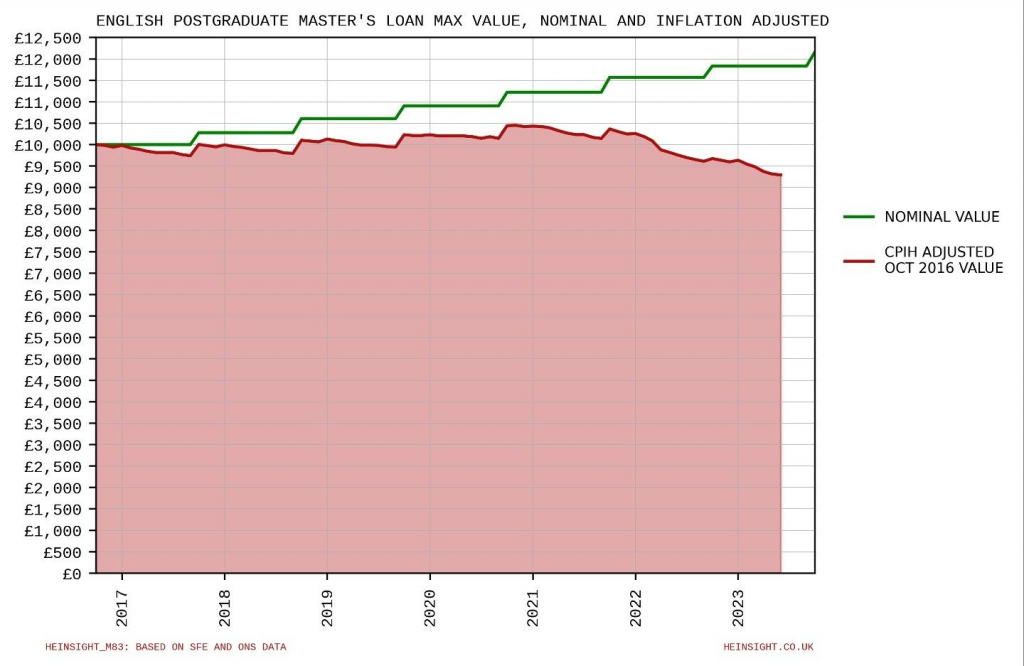
The maximum English Postgraduate Master’s Loan available has risen steadily since it was launched in 2016 but that hasn’t been enough to stop its real terms value being eroded by inflation since the pandemic.

The maximum loan for postgraduate students starting in 23/24 is currently worth £9,293 in October 2016 terms, a decline of 7% from its initial £10,000 value.

Categories
Inflation

Updated modelling: Inflation and the English UG tuition fee cap

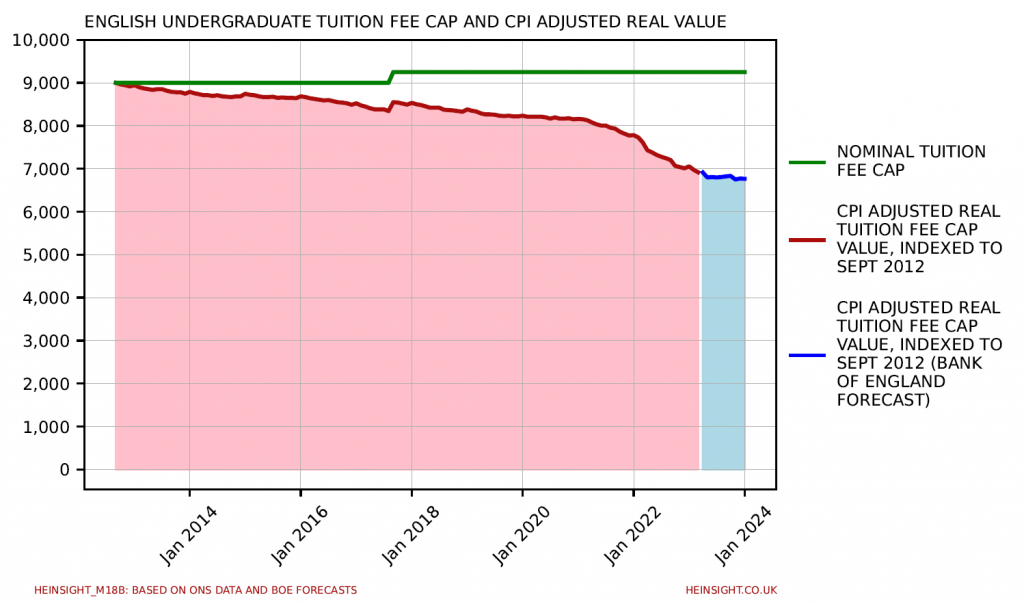
An update to our modelling of the English undergraduate tuition fee cap’s real terms value decline, based on the Bank of England’s latest CPI forecasts.

The BoE expects inflation to fall faster this year than it previously thought, though news today that CPI in March unexpectedly remained the wrong side of 10% may give pause for thought.

Of course, the C in CPI stands for Consumer. This rate represents costs for individuals, not universities. Whilst we might expect the two to move together fairly closely, a significant factor in the revision to the BoE’s forecasts for this year is the government’s changing interventions in residential energy costs. The Energy Price Guarantee doesn’t cover the commercial energy market of course, so these interventions won’t have a direct benefit for university balance sheets.

Categories
UCAS Statistics

UCAS January deadline statistics show drop in UK 18 year old application rate

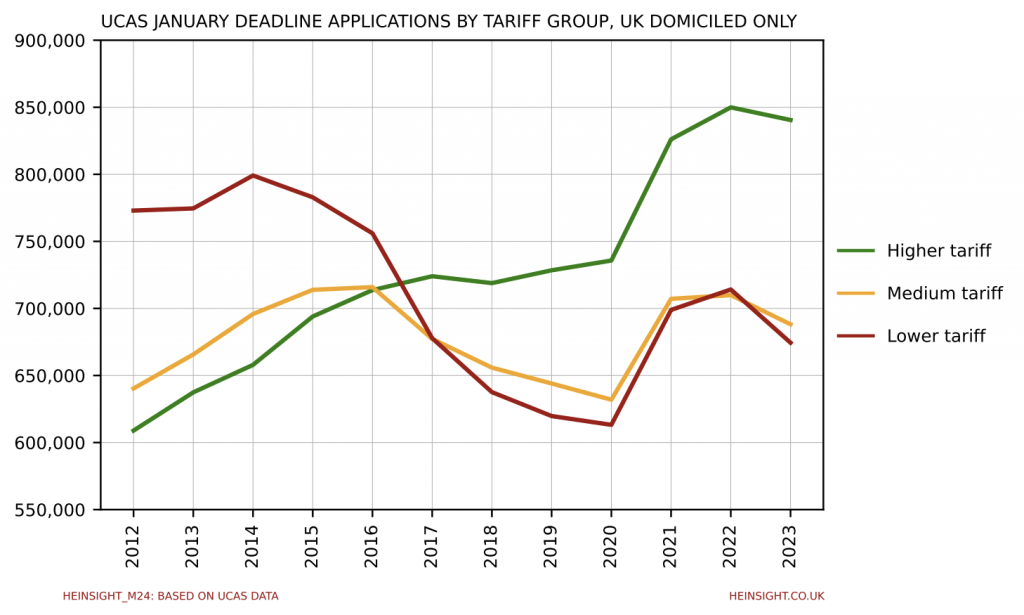
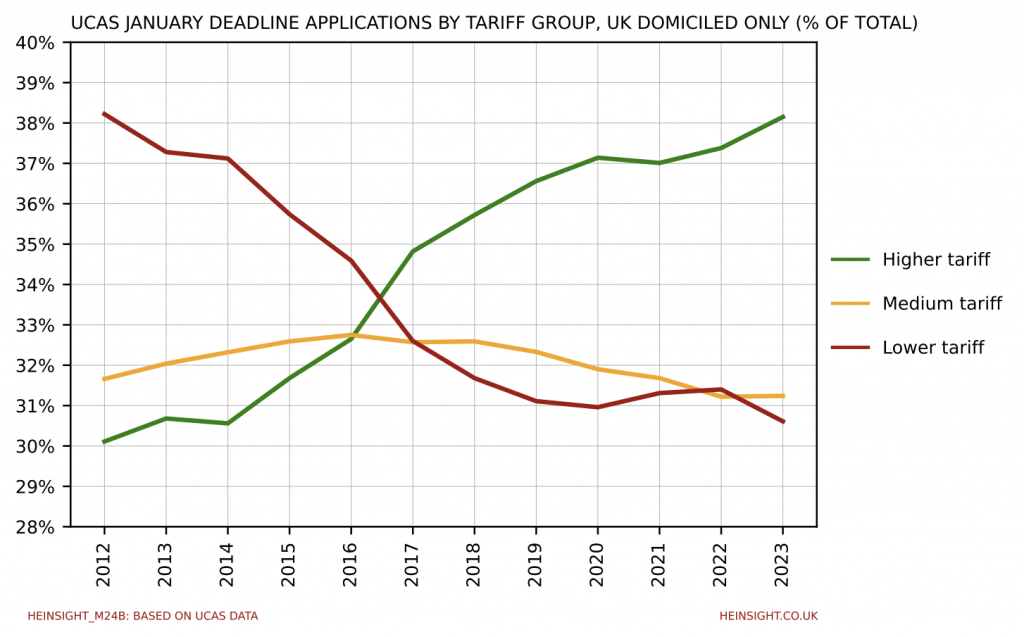
This week’s release of UCAS’s January deadline statistics confirmed some alarming news. Total UK applications submitted have fallen in spite of rising demographics, lowering the 18 year old application rate for the first time in many years.

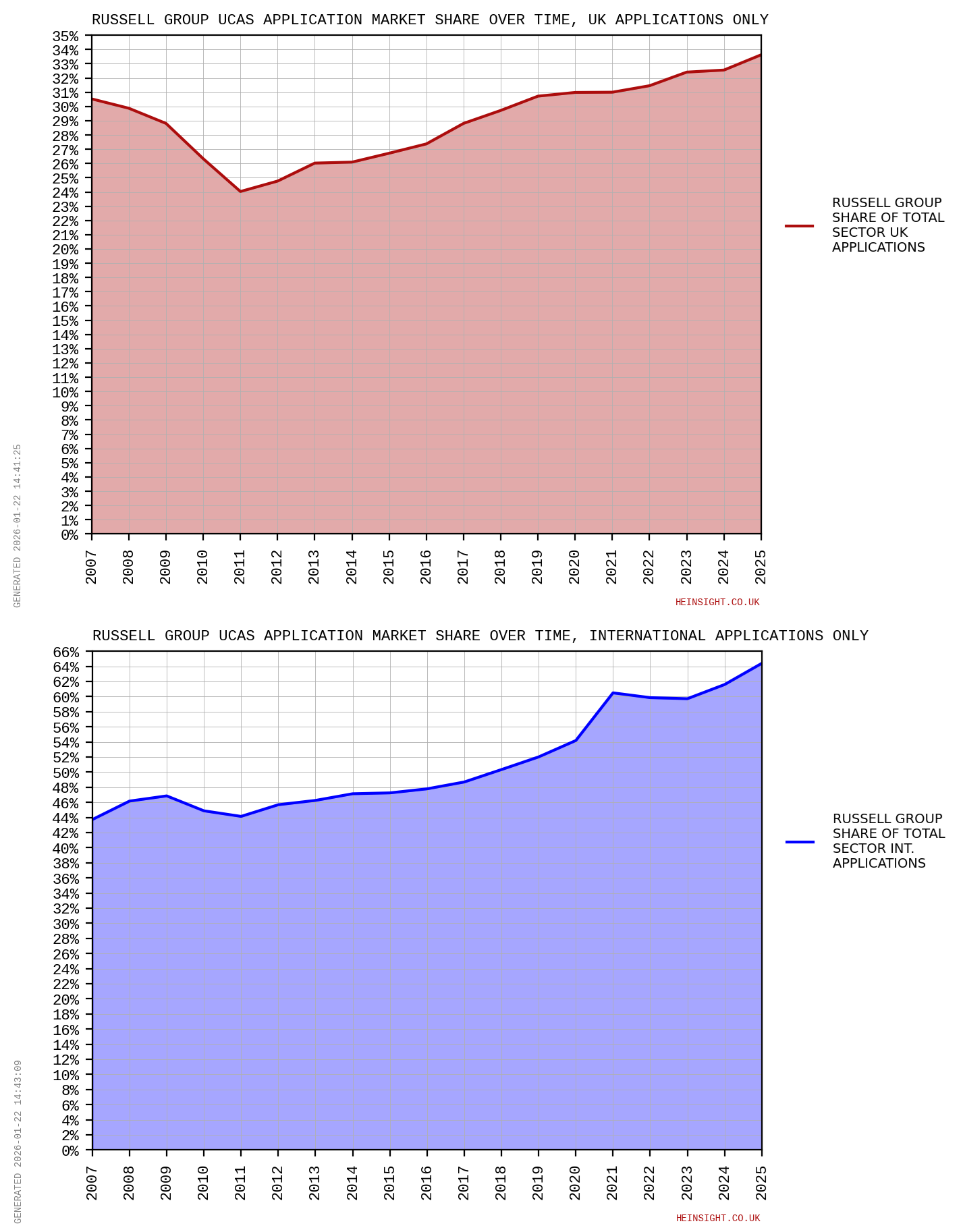
Examined by the tariff group, higher tariff institutions are continuing to receive ever higher shares of the total application pool despite already having reined in offer-making last year and many such institutions facing challenging capacity constraints. The lower- and medium-tariff institutions who are most likely to have capacity to grow meanwhile continue to be squeezed.

This mismatch in the distribution of supply and demand in the sector threatens not only many institutions themselves but also years of progress in raising entry rates and widening participation.

Categories
UCAS Statistics

Higher tariff institutions shrink their UK student intake

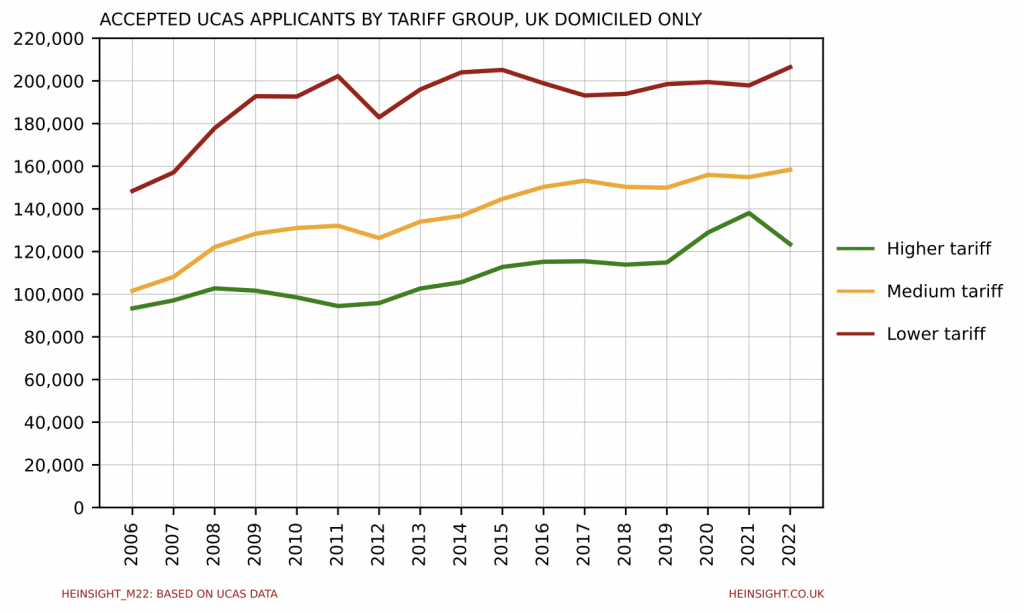
UCAS provider-level end of cycle statistics out today. As we already knew, entry rates for all UK nations have fallen along with total UK applicants accepted. It’s the higher tariff third of the sector driving this drop as they regain control over their intake and reduce offer making.

Categories
Pay

Measuring falling pay

No matter their grade, the real value of HE sector workers’ pay has been drifting downward for years and crashing since the pandemic.